
TEAM MEMBERS
1 product manager, 3 engineers
TIMELINE
Design: 1.5 months; build: 7 months

EvenUp is a legal AI company that specializes in personal injury law. The company was expanding from AI-powered document generationt tool into an end-to-end case management platform for personal injury law firms.
When something goes wrong on a matter, law firm staff lack a clear way to reconstruct what changed, when, and by whom to identify the cause.
Audit Log provides a complete, scannable history of matter activity with the ability to drill in for further details so teams can quickly trace changes and troubleshoot issues.

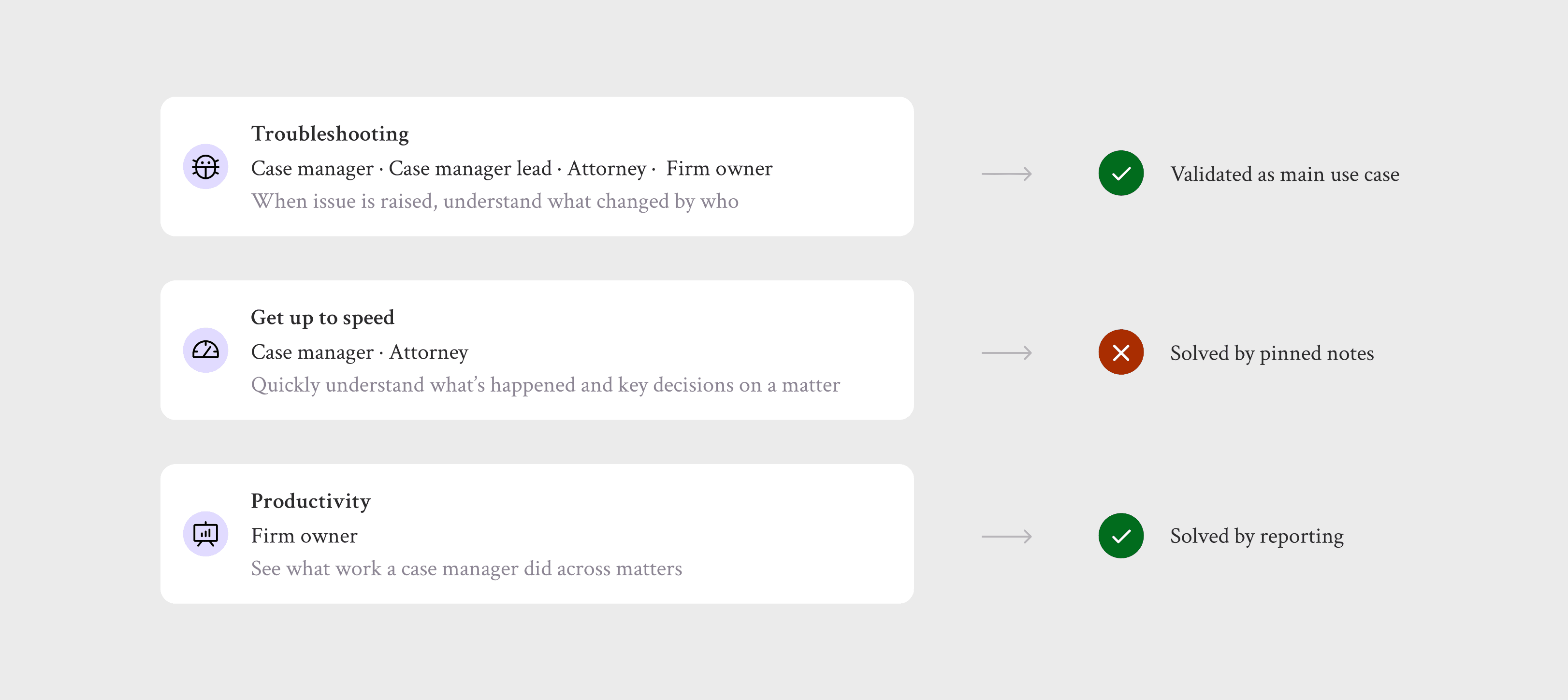
We explored three potential use cases for Audit Log. Customer research reinforced "troubleshooting" as the core use case, while the “get up to speed” hypothesized use case from leadership wasn’t strongly validated. Research also surfaced "productivity" as a real need, but we determined it was better served through Reporting.
Define the mental model
I started by mapping Audit Log, Notifications, and the Matter Timeline as separate surfaces, but that model broke down once we examined individual activities. Working with the Notifications designer, we developed a simpler model: everything that happens on a matter is an activity. Audit Log captures the complete history, while other surfaces show subsets relevant to their purpose.

Balance completeness and scannability
Rather than defining grouping behavior for every possible combination of activities, I worked with engineering to establish a scalable rule: group the same activities within an hour, while preserving chronology and meaningful distinctions between different activity types. This reduced noise without obscuring the information users need to troubleshoot what happened.

Sweat the details
What I learned at Slack is that craft has no shortcut. What it takes to go from good enough to great is more exploration and more iteration. I developed a methodology where I break up all detailed decisions and iterate on each one to push myself to sweat the details. Below are some examples of different aspects of the details I iterated on.
